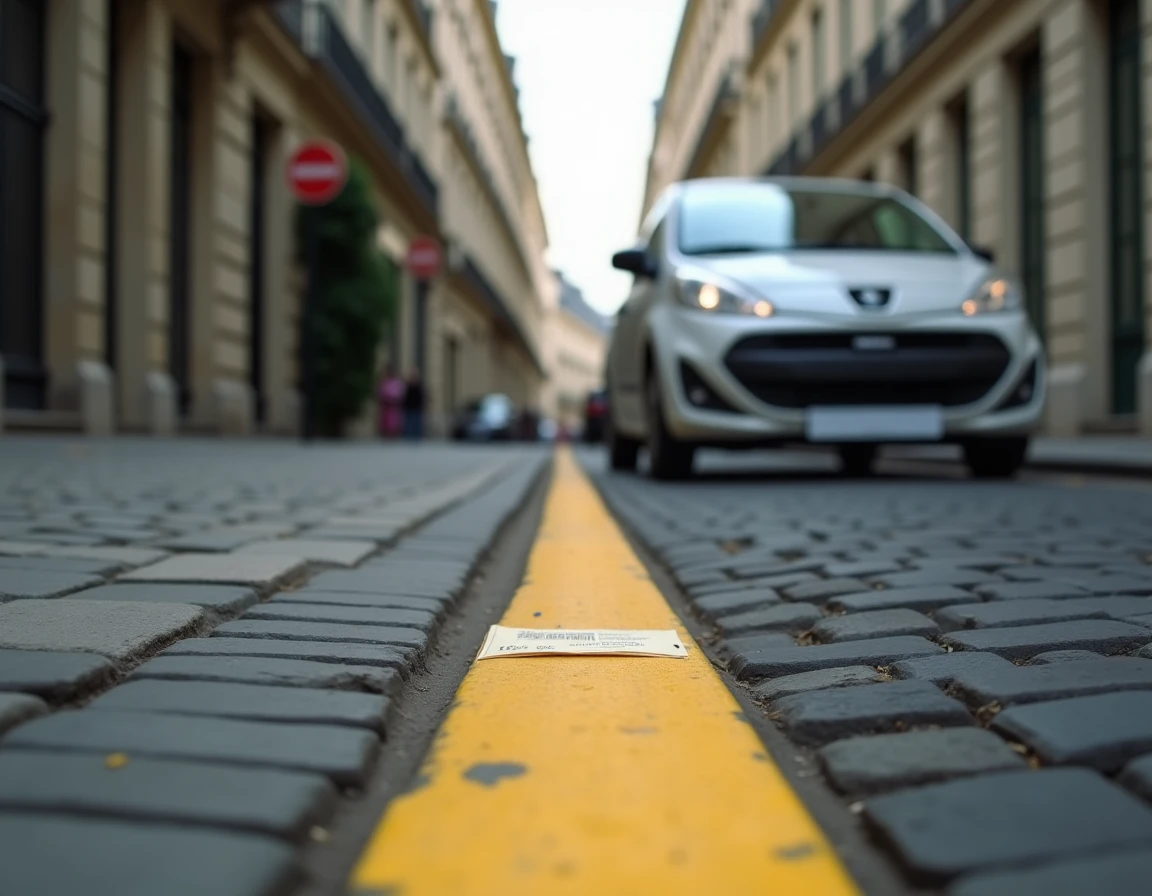
The yellow ground marking painted along a sidewalk falls under horizontal road signage as defined by the highway code. Depending on whether the line is solid or dashed, the rules applicable to the driver change significantly. Confusing the two can lead to a fine or even the towing of the vehicle.
Solid yellow line and dashed yellow line: two distinct regimes
A solid yellow line drawn at the edge of the roadway means that stopping and parking are both prohibited. The driver cannot turn off the engine or stop, even briefly, to drop off a passenger.
A dashed yellow line prohibits prolonged parking but generally allows for a short stop. The vehicle may stop for the time it takes to load or drop off, provided the driver remains in immediate proximity and can leave without delay.
The distinction is based on a simple criterion: the continuity of the painted line on the ground. By understanding the regulations for parking on yellow lines, a driver knows immediately whether they can stop or not, even before looking for an additional sign.
Municipal orders and local restrictions on yellow parking
The highway code sets the national framework, but each municipality can tighten the rules through municipal orders. Several major cities have recently reconfigured their delivery and short-stop zones in the city center.
The old yellow lines reserved for deliveries are gradually being paired with differentiated time slots. Deliveries allowed in the morning, short stops open to the general public in the afternoon or evening: the ground marking remains the same, but the applicable rule changes depending on the time.

A rarely discussed point concerns the dashed yellow line in the absence of a sign. On certain sensitive routes (near schools, hospital entrances), recent municipal orders have removed the tolerance for stopping normally associated with the dashed line. Without an additional sign, the basic rule can be locally restricted, and only the order displayed at the town hall or on the municipality’s website is valid.
Therefore, caution dictates that one should systematically check the vertical signage near the yellow marking, especially in municipalities that have changed their road regulations since 2022-2023.
Sanctions and vehicle towing: what a driver risks
Parking on a yellow line constitutes an offense of obstructive parking under the highway code. The standard penalty is a second-class fixed fine.
Since the generalization of the Post-Parking Charge (PPC), the distinction between types of fines has become more nuanced. In several large municipalities, parking on a yellow line is no longer treated as a simple failure to pay the parking meter. It falls under an obstructive offense requiring the intervention of the municipal police.
The concrete consequences go beyond the fine:
- Immediate towing of the vehicle is possible as soon as the parking is deemed obstructive or dangerous, without waiting for a grace period.
- Towing fees (towing, daily storage) are added to the fine amount and significantly increase the total bill.
- An appeal is possible with the municipality within a limited timeframe, but the burden of proof lies with the driver, who must demonstrate the absence or illegibility of the marking.
Temporary yellow marking: construction sites and work zones
In France, all temporary signage uses the color yellow. When a construction site necessitates a change in traffic, the yellow ground marking takes precedence over permanent white marking. This rule of priority applies to both lane markings and parking prohibitions.
A driver who parks in a normally permitted space but covered with fresh yellow marking therefore commits an offense, even if no construction sign explicitly mentions the parking prohibition.

At the end of the work, the temporary yellow marking must be removed. As long as it remains visible, it retains its regulatory value. In case of overlap between a construction yellow line and a permanent white line, the yellow takes precedence.
Special cases: zigzag, deliveries, and persons with reduced mobility
Zigzag yellow lines, drawn in front of schools or bus stops, indicate an area where parking and stopping are strictly prohibited. The zigzag shape serves to enhance the visibility of the prohibition.
Delivery spaces marked by yellow ground marking reserve the area for vehicles making a loading or unloading. A private vehicle parked in this space without delivery activity is subject to the same penalty as for obstructive parking.
For holders of a mobility inclusion card (CMI) marked “parking,” the general rule allows free and unlimited parking in reserved spaces. A solid yellow line remains enforceable: the CMI does not exempt from complying with a stopping prohibition.
- Solid yellow line: absolute prohibition, including for CMI holders.
- Dashed yellow line: stopping allowed, parking prohibited unless local exemption.
- Zigzag yellow marking: stopping and parking prohibited for all vehicles.
The yellow ground marking retains its full regulatory force as long as it remains legible, whether permanent or temporary. In the face of a yellow line whose meaning seems ambiguous, the most reliable approach remains to consult the corresponding municipal order, often accessible on the municipality’s website or posted at the town hall.